
What Homeowners Need to Know
In Fairfax County, porcelain berry became a major problem in Lewinsville Park, blanketing entire sections of woodland, requiring extensive removal efforts.This is just one of the thousands of infestations that are threatening trees around the county and which the community as whole will need to address if we are to save our trees.
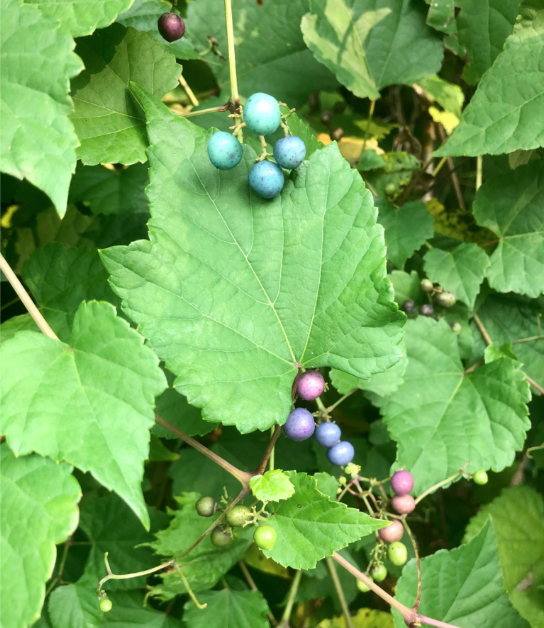
Porcelain berry (Ampelopsis brevipedunculata) looks beautiful — its bright turquoise, purple, and speckled berries appear most ornamental — but this vine is one of the most aggressive invaders in Mid‑Atlantic forests and neighborhoods. It climbs over shrubs and trees, forming dense mats that block sunlight, smother native vegetation, and destabilize forest edges.
Why Porcelain Berry Is a Problem
- Climbs and smothers shrubs, trees, and garden plants
- Blocks sunlight and prevents native plant regeneration
- Spreads rapidly along fences, hedgerows, and streambanks
- Produces abundant berries that birds spread widely
- Establishes quickly in disturbed or sunny areas
How to Identify It (See many photos from Fairfax observations on iNaturalist.)
- Bright, multicolored berries (turquoise, lavender, purple)
- Deeply lobed, grape‑like leaves
- Vines with speckled, peeling bark
- Tendrils that help it climb trees, fences, and shrubs
- Dense mats of layered vines that drape over vegetation
How It Spreads
- Birds and wildlife that eat the berries and disperse seeds
- Vines that climb and layer themselves over vegetation
- Root systems that resprout after cutting
- Rapid establishment in disturbed areas
How to Control It
Manual & Mechanical Control
- Pull young vines before they thicken
- Cut vines at ground level to stop climbing growth
- Dig out root crowns when possible
- Wear protective clothing — vines can be tough and tangled
Cut Stump Method
- Cut vines near ground level
- Immediately apply concentrated herbicide to the cut stump
Foliar Spray
- Apply from early summer into fall
- Effective on seedlings and resprouts
- For large infestations, cut vines first, then spray new foliage after regrowth
How to Tell Porcelain Berry from Native Wild Grape
- Berries:
Bright turquoise, purple, or speckled vs. dark purple - Leaves:
Deeply lobed vs. heart‑shaped or lightly lobed - Bark:
Speckled, peeling vs. fibrous, shredding - Growth Habit:
Dense mats that smother vegetation vs. less aggressive climbing
For More Information
Please visit Blue Ridge Prism Porcelain Berry Fact Sheet