
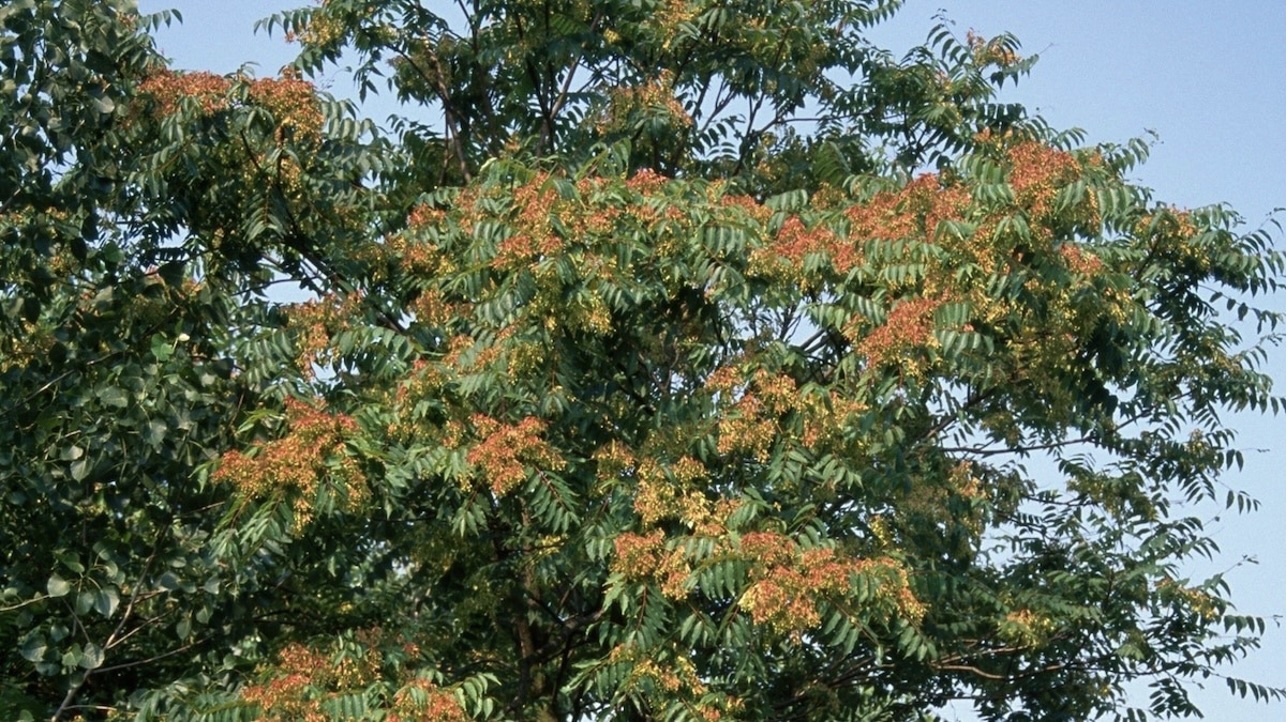
 An aggressive invader that poisons soil, forms dense thickets, and hosts the destructive Spotted LanternflyWhat Homeowners need to know
What Homeowners Need to Know
These things are essential to know. Please research the details before planning your treatment.
- If you cut down the tree without first killing it, you will make the problem much worse
- There is only a narrow time-window for killing it (late summer to early fall). It will take about a month to die.
- Except for seedlings that are small enough to pull out by the root, the only way to kill this tree is with herbicides.
Tree‑of‑heaven (Ailanthus altissima) is a fast‑growing invasive tree that spreads aggressively across fields, forests, roadsides, and urban areas. Although it was once planted as an ornamental, it is now recognized as a serious ecological and agricultural threat. This species is known to pollute the soil with toxic compounds that seep out of the roots and fallen leaves, allowing it to outcompete native plants and form dense stands that are extremely difficult to remove.
Even worse, Tree‑of‑Heaven is a preferred host of the invasive Spotted Lanternfly, a destructive insect that threatens fruit crops, vineyards, hardwoods, and landscape trees throughout the Mid‑Atlantic. There is evidence that removing Tree-of-Heaven can reduce the Spotted Lanternfly threat, presumably because birds don’t like the taste of the bugs that have been eating this non-native plant.
Why Tree‑of‑Heaven Is a Problem
Tree‑of‑heaven causes significant damage to natural areas, farms, and developed landscapes:
- Trees are weak‑wooded and prone to breakage
- Roots can invade sewer lines, foundations, and pavement
- Releases toxic chemicals that kill nearby plants
- Forms dense thickets that overtake pastures, hayfields, and forest edges
- Produces 300,000–350,000 wind‑dispersed seeds per mature female tree
- Sprouts aggressively from roots when cut
- Serves as a primary host for Spotted Lanternfly, increasing local infestations
Once established, this tree spreads rapidly and can dominate a site within a few years.
How to Identify It
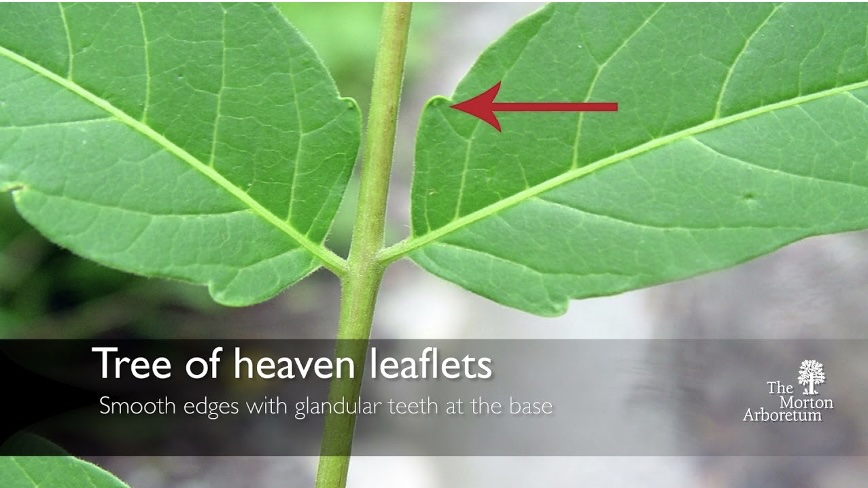 A key clue: Tree‑of‑Heaven leaflets have one or two notches with glands near the base, unlike ash or walnut
Tree‑of‑heaven is distinctive once you know the key features:
- Grows up to 80 feet tall with an open, irregular crown
- Smooth, pale tan bark when young; gray and still relatively smooth when mature
- Large, feather‑shaped leaves 1–4 feet long with 11–41 leaflets
- Leaflets have smooth edges except for one or two small notches near the base
- Notches contain small bumps or glands — a reliable ID clue
- Female trees produce large, showy seed clusters that turn yellow‑green to red‑brown
Crushed leaves or twigs smell like rancid peanut butter, a helpful identification tip
Where It Grows
Tree‑of‑heaven thrives in disturbed or sunny areas, including:
- Fields, pastures, and hayfields
- Forest edges, clear‑cuts, and young forests
- Roadsides, rail corridors, and powerline cuts
- Fencerows and hedgerows
- Urban areas — sidewalks, alleys, parking lots, building foundations
Its tolerance for poor soils and pollution allows it to spread aggressively in both rural and urban environments.
How It Spreads
Tree‑of‑heaven spreads by:
- Wind‑blown seeds — hundreds of thousands per tree
- Root suckers that emerge far from the parent tree
- Resprouting after cutting or damage
- Soil disturbance that exposes new areas for colonization
- Cutting alone often makes the problem worse by stimulating vigorous root suckering. It is imperative to kill the tree before cutting it down.
How to Control It
Because tree‑of‑heaven spreads by both seeds and roots, effective control requires killing the entire root system and preventing seed production.
Manual & Mechanical Control
- Hand‑pull young seedlings when soil is moist
- Remove the entire root to prevent regrowth
- Root suckers cannot be pulled — they break off and resprout
- Cutting alone is not effective and often increases suckering
Herbicide Options
In all cases, herbicides should only be used between late summer and early fall when the leaves start to turn color. Wait 30 days then cut down the tree, if necessary to eliminate any hazard. Different sizes of trees require different approaches:
Foliar Spray
- Effective on seedlings and small trees
- Avoid spraying desirable plants
Basal Bark Treatment
- For trunks 4–6 inches in diameter
- Apply herbicide in an oil carrier to the lowest 12 inches of trunk
Hack‑and‑Squirt
- For larger trees
- Make spaced cuts around the trunk and apply concentrated herbicide
Drill-and-Fill
- Alternative for larger trees
- Drill holes and fill with herbicide
Cut Stump Treatment (not recommended unless you have no other choice)
- If trees must be felled first, immediately treat the stump perimeter with herbicide
- Follow‑up is essential: treat new seedlings and root suckers for several years.
Look‑Alike Trees: How to Tell Them Apart
Tree of Heaven
- Leaf Margin: smooth
- Leaf/Branch Pattern: alternate
- Bark: smooth
Ash
- Leaf Margin: smooth
- Leaf/Branch Pattern: opposite
- Bark: rough
Staghorn Sumac
- Leaf Margin: toothed
- Leaf/Branch Pattern: opposite
- Bark: smooth
Walnut
- Leaf Margin: toothed
- Leaf/Branch Pattern: alternate
- Bark: rough
Source: Penn State Extension