
Many thanks to Blue Ridge PRISM, the preeminent provider of educational resources in Virginia, for laying out a clear process for creating an invasive plant management plan for a property.
Watch this video for an overview.

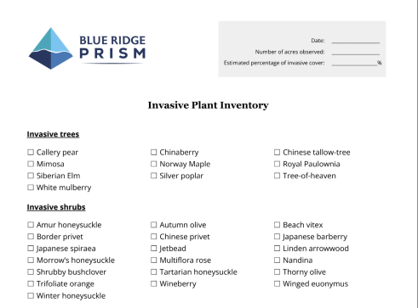
Start with a plant inventory
Every property is different. The types and amounts of invasive plants can vary, and every landowner may have different goals. Start by making a list—or even a map—of where the invasive plants are on your land. If you need help on a residential property, you can consult a volunteer from the Northern Virginia Bird Alliance Wildlife Sanctuary. For community common land or commercial properties, Fairfax PRISM volunteers can do a site visit and can also work with landscaping companies to point out which plants are invasive.
Prioritize
Common approaches
- Start at the top to protect the canopy and work your way down
- Vines that are hurting trees
- Invasive trees
- Invasive shrubs
- Ground level invasives
- Work from the outside in
- For bad infestations that you can’t control all at once. Starting on the outside keeps it from spreading further.
- Work from the inside out
- If you have good quality habitat that is surrounded by bad, gradually push back the bad stuff.
- Work uphill to downhill to try to avoid new seeds coming into cleared areas.
- Jump on new or uncommon invasive plants – Get rid of these as soon as possible, before they spread and become a bigger problem.
- Address worst damage – Focus on the invasive plants that are causing the most harm to the environment.
- Start where you can make a difference – Choose spots where your effort will really help in the long run. It’s smart to start where you can get results.
- "Shoot on sight" new or uncommon invasive plants or plants that you’ve already reduced to low numbers. When you see one, stop what you’re doing and get rid of it right away.
- How the area looks (aesthetics)
- What the public thinks or how they use the area
- How close the invasives are to public trails, streams, or other places that help them spread
Expect a Long-Term Process
Removing invasive plants usually takes several years. For example, you might need to treat most invasive vines for three years. Wisteria often takes five years to control.
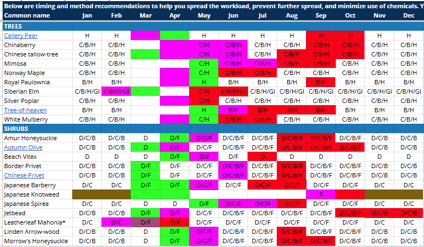
Time of year
- Winter is a great time to work on invasives or hire someone to help. There are fewer leaves, no ticks, cooler temperatures, and less poison ivy.
- Remove plants before they make seeds if you can. It’s also easier to pull smaller plants, though sometimes cutting them early can let them grow back and make fruit later.
- Herbicides work best at certain times. The timing depends on the plant. Look up the right schedule for each species. For example, cutting then painting the stumps works well with many species but cannot be done in the spring when the sap is rising.
Tip for Slopes: If you remove invasive plants like English Ivy from a steep hill, you can cover the area with a special net made of jute fiber to help keep the soil in place.
Community-wide priorities:
As you start to plan on a community-wide scale, you’ll need to think about which areas to prioritize first. New Hampshire’s Picking Our Battles document may give you some ideas.
Choose your weapons:
Any gardener has experienced the problem of staying on top of the weeds. In a small garden, you may (or may not) have time to do that just by hand pulling. On a larger scale, the time needed to do that using mechanical methods may be beyond your means to recruit a big enough volunteer pool or to pay for the labor. Since the invasive plants won't wait for us to gather our resources, you'll want to think carefully about the choices.
Mechanical removal - This New Hampshire document on Mechanical Control of Terrestial Invasive Plants explains the methods. Always read carefully about the target species, as some can be made much worse by attempting to treat by hand.
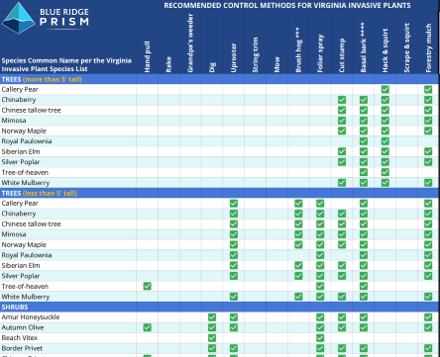
Chemical control - Herbicides are used, often in combination with mechanical methods, in three situations.
- Saving on time or labor costs. One person can accomplish in a couple hours what might take a crew all day to do manually. Repeat visits are always needed regardless of the method, but herbicides reduce regrowth significantly and have a much higher chance of achieving eradication.
- Addressing invasives on large areas. There simply are not enough willing people to manage large areas by hand.
- Controlling species for which mechanical attempts just makes the situation worse. Examples include Tree-of-Heaven, Mugwort, and Japanese Knotweed.
See our pages on Herbicide Safety and Herbicide Tips.